
CaffeinePouches.cc editorial guide · Reviewed 22 October 2026
Direct answer: A caffeine pouch assay close to a specification limit cannot be interpreted consistently unless the buyer and laboratory agree how measurement uncertainty will be handled. Request the measured result, reporting basis, uncertainty information and decision rule before relying on a pass/fail statement.
This guide addresses private-label procurement of nicotine-free caffeine pouches. It explains a laboratory reporting issue, not consumer dosing. Numerical examples are hypothetical and are not test results for our products.
What measurement uncertainty tells a caffeine pouch buyer
A laboratory measurement is an estimate with associated uncertainty. The value on a certificate should therefore be read alongside its method and reporting context. Do not confuse uncertainty with a known mistake, a permitted manufacturing tolerance or variation between individual pouches.
ILAC G8:09/2019 discusses decision rules and conformity statements under ISO/IEC 17025:2017. ILAC G17:01/2021 separately addresses uncertainty in testing. These references help frame questions for a laboratory; neither supplies a universal caffeine-pouch acceptance range.
Keep three questions separate
- Specification: what range has been justified and approved for this product?
- Measurement: what did the method estimate for the tested sample, and with what uncertainty?
- Decision: how does the agreed rule turn that evidence into a conformity statement?
A commercial label target does not, by itself, answer all three. For the rest of a report’s contents, start with our caffeine pouch COA guide.
A worked example: the same result, two different rules
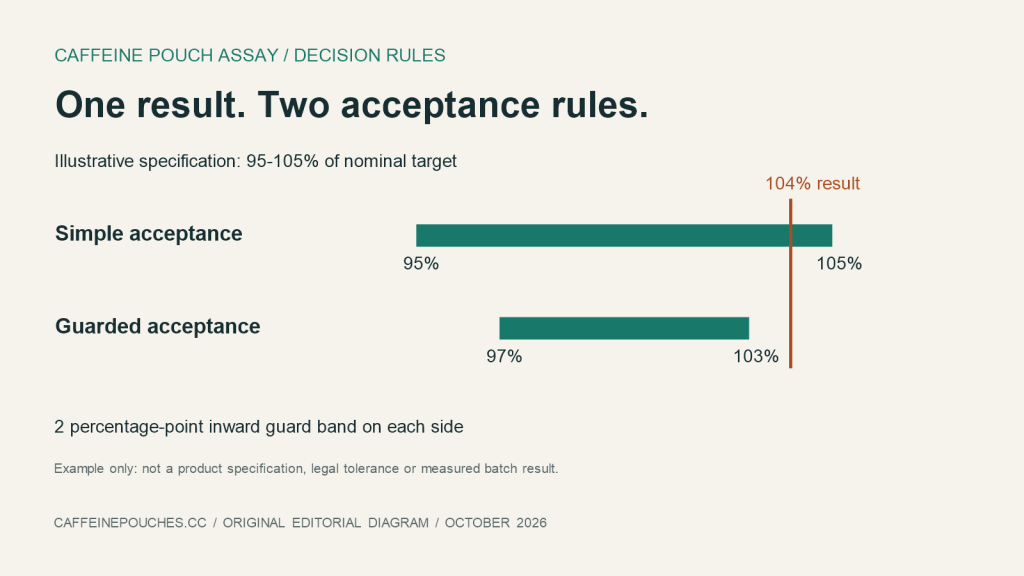
Assume an illustrative specification of 95–105% of a nominal target. A laboratory reports 104%, with expanded uncertainty of 2 percentage points. Assume this uncertainty applies to the reported result. These numbers are chosen only to demonstrate decision logic; they are not an industry standard, a legal labeling tolerance or a recommended product specification.
Simple acceptance
Under a rule that compares the measured value directly with the specification limits, 104% is inside 95–105%. That conclusion describes the chosen rule. It does not mean the uncertainty has disappeared or that every pouch in the batch has the same content.
An illustrative guard band
If the parties instead agree an inward guard band of 2 percentage points on both sides, the acceptance interval becomes 97–103%: 95 + 2 = 97 and 105 − 2 = 103. The 104% result falls outside that narrower interval. The specification itself remains 95–105%; the acceptance rule has changed.
The report wording must follow the agreed rule. A result outside the guarded acceptance interval is not automatically proof that the true content exceeds the specification. Whether the report uses a binary decision or another defined category must be settled in advance.
ILAC’s G8 guidance explains guard bands and the associated decision risks. This simplified calculation illustrates those concepts and does not replace a laboratory’s documented rule.
Questions to settle before sending samples
Define the measurand and sample
State that the requested measurement is caffeine content and specify its basis: milligrams per pouch, milligrams per gram of fill or percentage of a nominal target. Identify whether the laboratory will test individual units or a pooled sample. A result for pooled material cannot establish the spread of results among individual pouches.
Also identify whether the wrapper is included in the sample preparation and whether the result is reported as received or on another stated basis. These are practical request-form details that prevent apparently similar reports from answering different questions.
Request a complete uncertainty statement
- Ask whether the value is standard or expanded uncertainty.
- Request its units and whether it is absolute or relative to the measured result.
- For expanded uncertainty, ask for the coverage factor and the laboratory’s stated interpretation.
- Clarify whether sampling uncertainty is included or the statement applies only after receipt of the submitted sample.
- Confirm that the uncertainty estimate is relevant to the method, concentration and flavored pouch matrix being tested.
Do not silently read “±2%” as two percentage points. For a result of 104% of target, a relative uncertainty of 2% corresponds to 2.08 percentage points. The reporting convention must be explicit before doing the calculation.
Why two laboratory reports can appear to disagree
Before treating different pass/fail labels as conflicting science, compare sample identity, analytical basis, method version, uncertainty convention and decision rule. One report may assess a composite while another assesses individual units. One may apply a guard band while another uses simple acceptance.
Send both laboratories a common comparison sheet rather than asking only for a repeat test. If the measured values themselves differ materially, request an investigation of method suitability and sample handling. Changing the rule after seeing an inconvenient result does not explain the discrepancy.
When the question is batch variation rather than measurement interpretation, use a separate content uniformity sampling plan. Additional decimal places on a pooled assay do not substitute for that evidence.
A practical purchase-order attachment
Attach a short testing agreement to the order: product and formula revision, lot identification, sampling responsibility, analytical method, reporting unit, specification revision and conformity rule. Name who can authorize a deviation and how unresolved results will affect shipment. Keep the approved version with the final laboratory report.
For a new project, provide these details alongside the sample-kit evaluation brief. This makes laboratory cost and turnaround estimates more meaningful and reduces disputes about what the test was intended to prove.
Frequently asked questions
Does a small uncertainty mean the whole batch is uniform?
No. Measurement uncertainty and unit-to-unit variation answer different questions. Batch uniformity depends on an appropriate sampling and testing design.
Must every caffeine pouch buyer use a guard band?
No universal rule is proposed here. The applicable requirements and the agreed conformity rule determine how uncertainty is used.
Can the buyer choose a rule after receiving the result?
Settle it before testing. If the original agreement is incomplete, document the clarification transparently rather than presenting a newly selected rule as the original criterion.
Does ISO/IEC 17025 accreditation certify the pouch product?
No. Check the laboratory’s relevant scope and report. Laboratory accreditation does not constitute approval or certification of every product it tests.
References and editorial scope
Primary references: ILAC guidance series, including G8 and G17; ILAC G8:09/2019, hosted by the Department of Standards Malaysia. The procurement checklist and numerical scenario are original editorial explanations. No customer results, laboratory accreditation or product certification are claimed.