
CaffeinePouches.cc editorial guide · Reviewed 22 October 2026
Direct answer: Before changing a caffeine pouch ingredient or packaging supplier, document the exact change, assess its effect on the finished product and approve the supporting evidence before routine production. Matching a material name or purchase specification is not enough to establish that the finished pouch will perform the same way.
This is a practical quality-agreement framework for private-label nicotine-free caffeine pouches. It covers changes after a formula and package have been approved, rather than initial supplier selection. It does not claim that a particular supplier or product already operates this system.
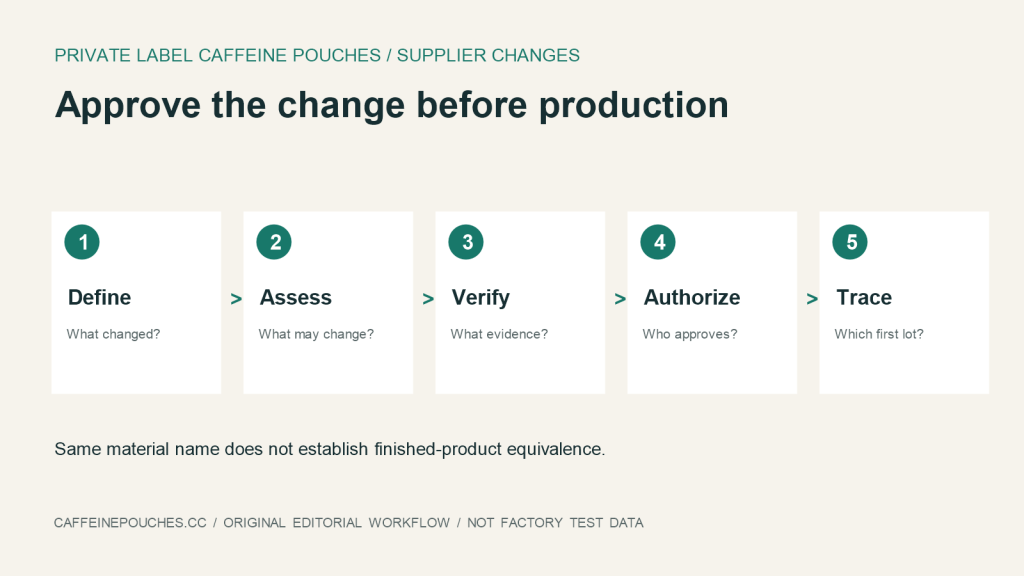
What belongs in a change-control request?
A useful request compares the approved state with the proposed state. Identify the material code, manufacturer, manufacturing site, specification revision and reason for the change. Include the first proposed production date and any stock that could be affected. “Equivalent supplier” is a conclusion to support, not a complete change description.
Changes that deserve an explicit review
- A new source or grade of synthetic caffeine.
- A different flavor carrier, sweetener grade or cooling ingredient.
- A revised nonwoven fabric, seam construction or pouch dimension.
- A change in can resin, liner, closure, seal material or printing system.
- A manufacturing-site transfer or material process change.
- A new assay method or laboratory where comparability matters to release decisions.
For supplier selection before approval, see how to choose a private-label caffeine pouch manufacturer. Change control adds a different question: what evidence from the old arrangement still supports the new one?
Match the evidence to the change
Caffeine source or grade
Compare identity, assay basis and relevant material characteristics, then evaluate whether the change could affect processing or finished-product consistency. Two materials can share a chemical name while differing in a physical attribute important to handling. Ask the manufacturer which attributes matter to the approved process and why.
If the product brief specifies pure synthetic caffeine with no guarana, a switch to botanical caffeine is a formula and positioning change, not merely a cheaper purchasing option. Review ingredient descriptions and claims as well as analytical performance.
Flavor or sweetener system
Record the complete proposed material identity, including carrier information available to the manufacturer. Review any effects on ingredient declarations, allergen assessment and sensory references. A similar flavor name does not establish that the replacement behaves identically in the finished pouch.
Use the approved reference product to define the comparison. Decide beforehand which attributes matter, such as bitterness balance or cooling intensity, rather than accepting an unrecorded statement that a sample tastes fine.
Nonwoven fabric and can components
For a pouch-material change, consider the relevant dimensions, sealing performance and intended-use evidence. For a can or liner change, consider closure compatibility, barrier performance and applicable food-contact documentation. Refer to our nonwoven material guide for the initial specification questions.
The European Commission’s food-contact legislation overview describes documented quality assurance and quality control under Regulation (EC) No 2023/2006. This is relevant where the material and intended use fall within that framework. A generic “food grade” statement is not a substitute for checking the actual material, use conditions and destination requirements.
Use a defined comparison protocol
The following is an editorial workflow for a buyer and manufacturer to adapt, not a universal validation protocol. The scope should reflect the change’s potential effects and applicable obligations.
- Freeze the baseline: identify the approved formula, material specifications, package construction and reference samples.
- List possible consequences: connect each changed attribute to the product characteristic it could affect.
- Choose relevant evidence: document which supplier records, production observations and finished-product checks will answer those questions.
- Set acceptance criteria: agree them before reviewing the comparison results.
- Record the decision: approve, reject or request more evidence, with a named owner and implementation conditions.
For example, a new can liner may justify package-specific compatibility and stability work even when the formulation stays constant. An unchanged caffeine assay alone would not answer the liner question. Conversely, a purely administrative supplier-address correction may need document verification rather than an unnecessary full testing program.
Decide which old evidence can be carried forward
Create a short evidence map with three entries for each relevant claim or specification: the supporting document, whether it still applies and the reason. This prevents a previous shelf-life report from silently being used for a materially different packaging system.
Do not automatically restart every study or automatically reuse every study. The responsible quality team should explain which bridges are justified and which gaps need new evidence. Our stability and shelf-life guide explains why the tested product-package combination matters.
Where a product is lawfully classified as a dietary supplement in the United States, FDA’s small-entity CGMP guide describes specifications, manufacturing records and quality-control responsibilities under 21 CFR Part 111. A caffeine pouch is not automatically a dietary supplement; confirm classification before applying that framework.
Control the first changed batch and remaining stock
Assign a clear effective point, preferably an identifiable batch rather than only a calendar date. Link the material revision to the finished-product lot and record which artwork revision was used. State how remaining old materials and finished goods will be handled, including whether coexistence is permitted.
A practical release packet should include the approved change request, supporting comparison, revised controlled documents and the first affected lot. If the change is temporary, define its duration, quantity or expiry condition and the requirements for returning to the approved baseline. Urgent purchasing pressure does not remove the need for a documented disposition.
What to put in the supplier quality agreement
- Which changes require prior notification and which require buyer approval.
- Who supplies technical evidence and who makes the quality decision.
- How lead time for review is agreed; do not assume a universal notice period.
- How the first affected batch, revised specifications and artwork are identified.
- How deviations, temporary substitutions and unresolved assessments affect shipment.
- Who reviews whether the change achieved its intended result after implementation.
Bring this checklist to the next OEM review alongside your packaging and labeling brief. It makes the approved product reproducible across future purchase orders instead of relying on the memory of a sample approval.
Frequently asked questions
Does an unchanged caffeine amount mean a supplier change is minor?
No. Packaging, flavor, processing and labeling effects may still require review even when the nominal caffeine target remains unchanged.
Can two suppliers share one approved material specification?
Potentially, if each is qualified for the intended use and the relevant evidence supports the arrangement. A shared specification alone does not establish interchangeability.
Must every change trigger a new shelf-life study?
No automatic rule is proposed. Assess whether the existing evidence still supports the changed product-package system and document the justification.
How many pilot batches are always required?
There is no universal number in this guide. The change, process knowledge, risk and applicable requirements determine the evidence needed.
References and editorial scope
Primary references: European Commission food-contact materials legislation overview and FDA dietary supplement CGMP small-entity guide. The workflow is an original procurement recommendation. These references do not establish product classification, regulatory approval or supplier certification.