CaffeinePouches.cc editorial team · Published 29 October 2026
A caffeine pouch release test measures how much caffeine enters a defined liquid over time. Its value depends on the test method, sampling plan and analytical recovery. A release percentage alone cannot establish how much caffeine reaches the bloodstream.
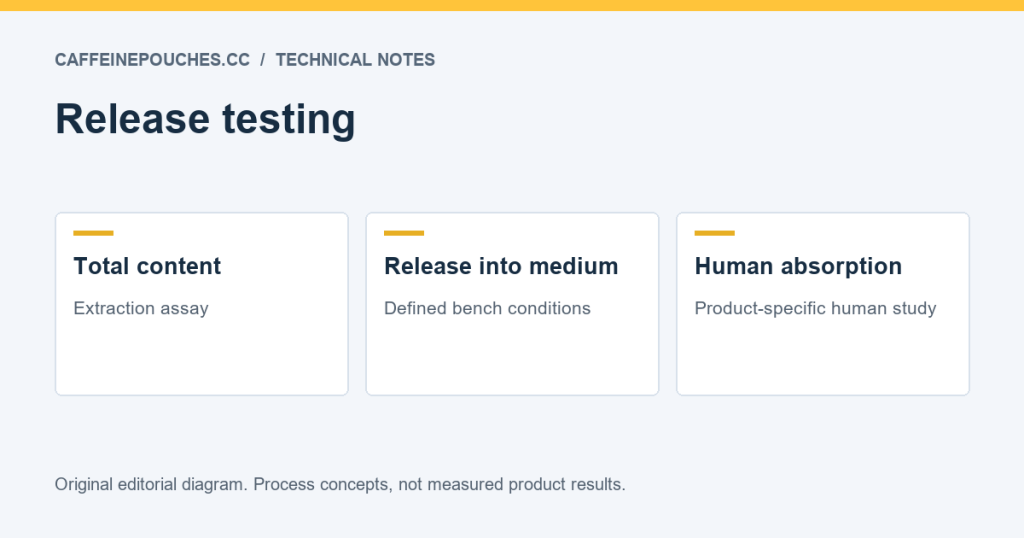
Separate total content, release and absorption
A finished-pouch assay measures the caffeine recovered by an extraction method intended to determine total content. A release experiment follows caffeine leaving the pouch under selected conditions. A human pharmacokinetic study measures concentrations in biological samples over time. These measurements answer different questions.
FDA’s guidance on in vitro/in vivo correlations describes the evidence used to connect dissolution and human performance for extended-release drugs. It is pharmaceutical guidance, not a caffeine-pouch approval pathway or a ready-made pouch test. A supplier should explain any claimed connection between its bench test and human use with product-specific evidence.
Agree on the method before comparing suppliers
Control the liquid and apparatus
Request the medium composition, pH, volume, temperature, agitation and pouch position. Record whether the pouch floats, is restrained or is compressed. A liquid called “artificial saliva” still needs a recipe. Two laboratories can produce different curves from the same pouch if one uses a larger liquid volume or different mixing conditions.
- Identify the formulation, strength, pouch fabric, fill weight and batch.
- Specify the number of individual pouches and report their separate results.
- State sampling times, sampled volume and whether fresh medium replaces each sample.
- Define filtration, dilution, calibration and the analytical method used to quantify caffeine.
- Explain the calculation used to correct for caffeine removed in earlier samples.
Check recovery before trusting a low result
Caffeine can be under-reported if extraction is incomplete or the sample preparation loses analyte. Ask how the laboratory assessed recovery from the actual formulation and whether the pouch fabric or filter affected the measurement. A blank medium and a suitable control help distinguish product behavior from a method problem.
State the denominator on every percentage
Consider an illustrative pouch with a 50 mg label claim and a measured total content of 48 mg. If the medium contains 24 mg at a sampling point, that is 48% of the label claim but 50% of the measured content. Both calculations are arithmetically correct; they describe different denominators. These figures are a worked example, not results from a product sold on this site.
Ask for released mass in milligrams alongside the percentage. Keep a record of the remaining caffeine in the pouch when the protocol includes a residual extraction. Unexplained gaps in a mass balance need investigation before the curve is used to choose a formula.
Write a useful purchasing specification
A purchasing specification should name the method revision, time points, acceptance criteria and handling of individual failures. Agree these before samples arrive. Compare an approved reference batch with development batches under the same protocol, and document why any proposed limits suit the product.
Laboratory competence also needs a specific check. ISO/IEC 17025:2017 addresses testing and calibration laboratory competence. Ask the laboratory which parts of the assay and release work fall within its accreditation scope; accreditation alone does not establish that a custom release method predicts absorption.
Keep marketing claims within the evidence
A statement such as “released under the stated laboratory conditions” can describe a bench result accurately. Claims about onset, absorbed dose or duration require evidence addressing those outcomes. Mouthfeel, cooling and perceived strength should be recorded separately from the chemical analysis.
Frequently asked questions
Does 80% release mean 80% absorption?
No. It describes release into the specified test medium. Absorption requires evidence about uptake in people.
Can two release curves be compared directly?
Only after checking that the methods, sample handling, calculations and reporting units are comparable.
Is there one release target for every caffeine pouch?
This article does not establish a universal target. Define a product-specific protocol and justify its limits before using it for batch acceptance.
References
- FDA: In vitro/in vivo correlations for extended-release oral drugs
- ISO/IEC 17025:2017: laboratory competence
Related reading
For a project-specific specification, send your formula, packaging format and target market to our team.