CaffeinePouches.cc editorial team · Published 29 October 2026
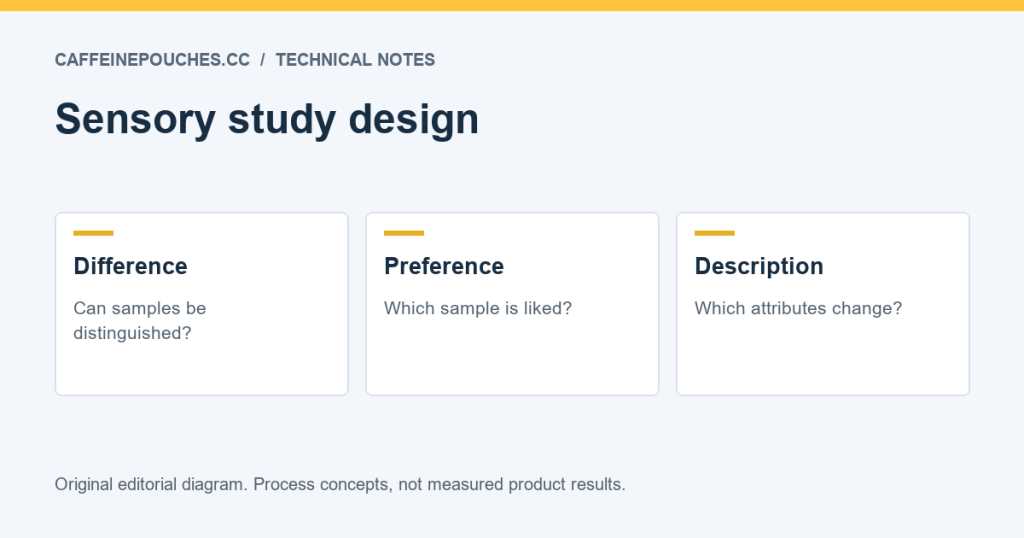
Choose the sensory question before selecting the panel. A difference test asks whether samples can be distinguished. A preference test asks which sample people like. A descriptive assessment records attributes such as bitterness, cooling or fabric feel.
Choose a test that answers the decision
A flavor substitution may need a difference assessment against an approved reference. A launch team choosing between two new flavors may need preference research with suitable adult users. A formulation team adjusting bitterness needs attribute-level feedback. Mixing these questions into a single “Which is best?” score produces a result that is hard to act on.
ISO 4120:2021 describes a forced-choice triangle test for sensory difference or similarity. It does not identify the size or direction of a difference, and it has limitations for products with lingering flavors. That limitation matters when evaluating cooling or strongly flavored oral pouches.
Remove clues that reveal the sample
Code samples and control the serving order
Use neutral codes that do not reveal brand, price, formula revision or expected performance. Keep the decoding sheet separate from the assessor’s form. Balance serving order across participants so that one sample does not always arrive first. Match presentation, handling and storage as closely as the study requires.
In a conventional triangle design, each set contains three coded presentations, two from one product and one from the other. Choosing the odd sample by chance has a probability of one in three. One person’s correct choice therefore provides little evidence on its own. Set the panel size and statistical decision rule before collecting responses, with help from a sensory professional where needed.
Control carryover and caffeine exposure
Persistent cooling, sweetness or bitterness can alter the next assessment. Define session spacing and recovery conditions during protocol development. Simply giving more samples in the same sitting can make the result less interpretable. A caffeine-free prototype can help screen some flavor choices, but removing caffeine changes the formulation and may change its sensory behavior.
Screen participants and have a responsible professional define exposure limits and stopping criteria. Account for caffeine from all study samples and other sources. FDA cites 400 mg per day for most adults as an amount not generally associated with negative effects; that is not a study allowance, a recommended intake or a guarantee for an individual. Do not ask people to continue through irritation or discomfort.
Make the response sheet specific
- State the question: detectable difference, preference or named sensory attributes.
- Use the same attribute definitions and scale anchors for everyone.
- Separate aroma, sweetness, bitterness, cooling and pouch texture where relevant.
- Record the observation time so early and late impressions are not mixed.
- Capture incomplete sessions and discomfort reports instead of discarding them silently.
A descriptive scale can use anchors such as “not detected” and “very intense,” provided assessors understand them consistently. An intensity score is not a liking score. A stronger mint impression can be preferred by one group and disliked by another.
Report what the panel actually established
Keep the sample codes, formulation revisions, participant criteria, raw responses and analysis with the report. State the question, method and decision rule. If a difference test fails to detect a difference, do not automatically call the products equivalent; a similarity study needs an appropriate design and sufficient sensitivity.
Use the outcome to make the next decision explicit: retain the reference, revise the candidate, or commission preference work. Avoid turning a small internal panel into a claim about all customers.
Frequently asked questions
Does a triangle test identify the better flavor?
No. It assesses sensory discrimination or similarity under its design. Preference requires a separate question and suitable participants.
Can a staff tasting replace consumer research?
Staff feedback can guide development. It should not be described as representative consumer preference without an appropriate sampling design.
How many assessors are needed?
The number depends on the method, risks of incorrect conclusions and effect or similarity criterion. Agree the design before recruiting rather than choosing an arbitrary panel size.
References
Related reading
For a project-specific specification, send your formula, packaging format and target market to our team.