CaffeinePouches.cc editorial team · Published 29 October 2026
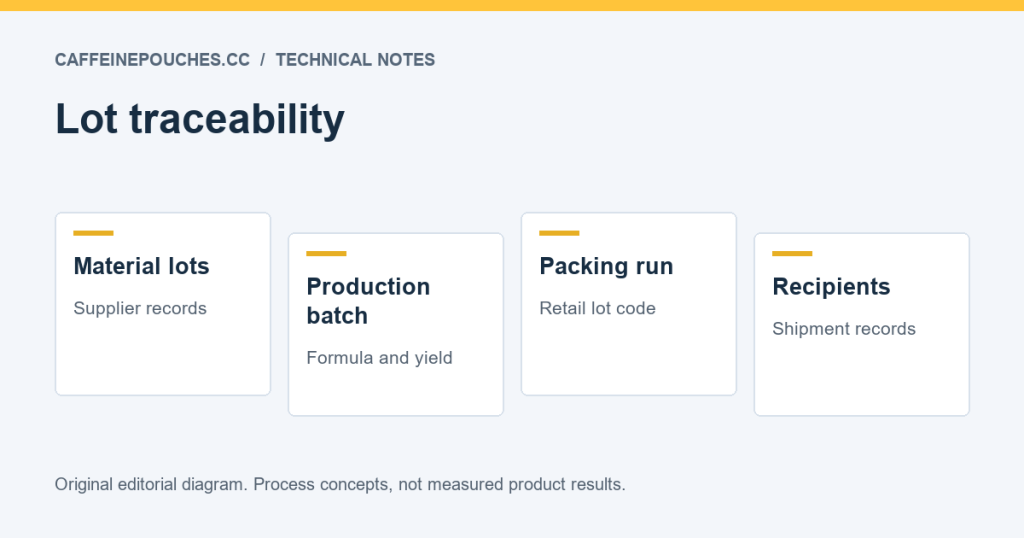
A useful traceability exercise starts with a real lot code and ends with a reconciled inventory, a recipient list and a record of unresolved gaps. Private label brands need links between ingredient lots, manufacturing batches, packed cans and shipments.
Make the retail code connect to the production record
A date printed on a can is not enough if several formulas, packing runs or factories share that date. Agree how the retail lot code identifies the manufacturing batch and packing run. Preserve the relationship when bulk pouches are packed on a later day or split between different labels.
The buyer should be able to work in both directions: from a retail can to the materials used, and from a questioned material lot to every finished batch that used it. Neither direction should depend on one employee remembering what happened.
Minimum links to include in the exercise
- Caffeine and other ingredient supplier lot numbers, receipt quantities and release status.
- Formula revision, blend record, production date and equipment or line identification.
- Pouch material and packaging lot references, including the label artwork revision.
- Finished batch quantity, rejected stock, retained samples and any rework.
- Warehouse locations, shipment references and direct recipient contact details.
Set the scenario and responsibilities
Use a plausible scenario such as an incorrect label strength or a supplier notification concerning one ingredient lot. Write down the scenario without presenting it as a real incident. Assign an exercise coordinator and record who can place stock on hold, obtain distribution records and approve customer communications.
For foods subject to the relevant US preventive-control requirements, 21 CFR 117.139 requires a written recall plan when a hazard requires a preventive control. Its provisions address direct consignees, public notification where appropriate, effectiveness checks and disposition. Whether this framework applies to a particular caffeine pouch depends on its classification and circumstances. A mock exercise does not replace a required recall plan.
Reconcile the quantities in one unit
Choose cans, pouches or another defined unit and convert every record consistently. If the packed batch contains 10,000 cans and the records show 6,000 shipped, 3,800 held, 100 retained and 100 rejected, all 10,000 are accounted for. Those are fictional training figures. A reconciliation of 9,950 would leave 50 cans to explain.
Document what “shipped” includes. Transfers to a third-party warehouse can be mistaken for customer deliveries, and returned stock can be counted twice if it remains in both the shipment and warehouse totals. Record the time at which inventory was frozen for the exercise.
Measure completeness and response time separately
Record when the exercise began, when the first recipient list was available and when the final quantities were reconciled. A fast spreadsheet with missing distributors is incomplete. Set an internal response target that fits the business, but do not present an arbitrary two-hour or four-hour target as a universal legal requirement.
Close the gaps found during the exercise
For each missing link, assign an owner and a completion date. Repeat the failed step after the correction. A revised form is not evidence that the new process works; retrieving a previously missing packing-to-shipment link is.
Keep exercise communications clearly marked as simulations. Do not send an apparent public recall notice during a drill. For an actual safety concern, follow the established escalation process and applicable reporting duties rather than waiting for a scheduled exercise.
Frequently asked questions
Does a barcode provide complete traceability?
A barcode can identify a record. Traceability depends on the linked ingredient, production, packing and distribution records being accurate and retrievable.
Should the brand or manufacturer run the drill?
Define responsibilities in the quality agreement. An exercise spanning both organizations can reveal gaps that an internal factory drill misses.
Does 100% reconciliation prove the batch is safe?
No. It shows that the chosen quantities were accounted for. Safety and conformity require their own assessment.
References
Related reading
For a project-specific specification, send your formula, packaging format and target market to our team.