CaffeinePouches.cc editorial team · Published 29 October 2026
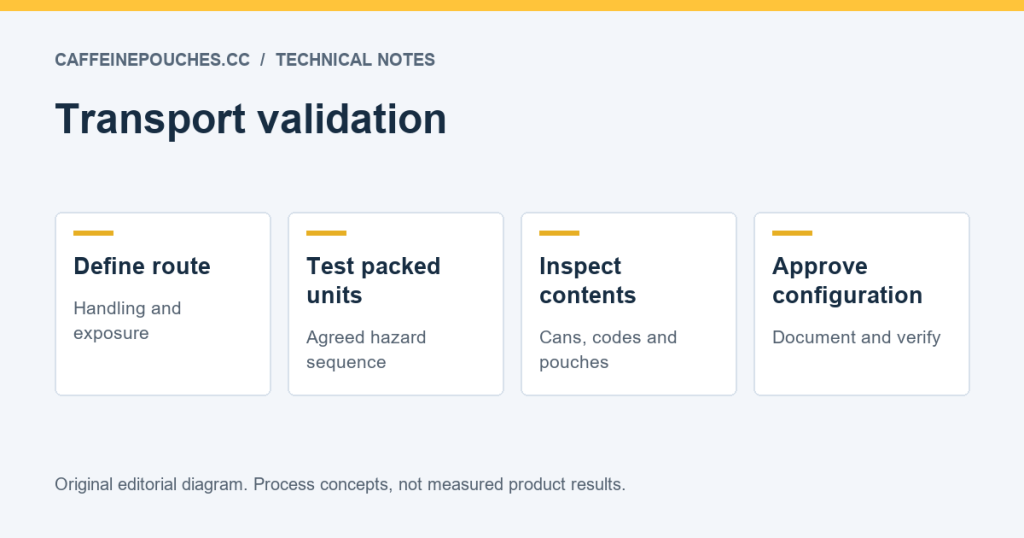
Transport validation tests the packed shipping unit against a defined distribution route. For caffeine pouches, inspect the retail cans, closures, labels and pouches after testing as well as the outer carton. A clean-looking carton can conceal a damaged closure.
Describe the route before selecting the test
List the shipment stages: factory storage, pallet loading, freight, distribution-center handling and the final delivery. A palletized wholesale shipment and a parcel sent to a customer face different handling conditions. Record expected stack loads, handling frequency and any known temperature or humidity exposure.
ASTM D4169 provides a framework for laboratory evaluation of shipping units against distribution hazards. Its official scope also points to D7386 for single-parcel shipments. Ask the packaging laboratory to identify the selected standard edition, distribution cycle and severity, and explain why they fit the route. A standard number on a quotation is not a complete protocol.
Test the configuration that will actually ship
- Use the approved can, closure, liner or seal and pouch count.
- Identify the retail label material and application method.
- Specify carton grade, dimensions, dividers, packing orientation and gross weight.
- Record pallet pattern, overhang, wrapping and strapping where used.
- Include the conditioning and test sequence in the approved plan.
Keep photographs and a bill of materials with the report. A result for a small carton does not automatically cover a larger carton filled with more cans. A change in divider layout or closure can alter performance even when the printed packaging looks the same.
Separate mechanical damage from environmental exposure
Drop, vibration and compression work addresses physical hazards. Heat and humidity exposure may affect labels, moisture movement or the product itself and needs a justified protocol. Passing a mechanical sequence does not establish a shelf life or prove that every transit temperature is acceptable.
For packaging components, FDA’s food-contact regulatory-status guidance explains that suitability depends on the substance and its authorized conditions of use. A transport test is separate from food-contact documentation. Ask for evidence covering the intended material, product contact and use conditions.
Define failure before the cartons arrive at the lab
Agree acceptance criteria for both function and appearance. A small scuff may be acceptable for a wholesale carton while an unreadable lot code is not. Define how damaged seals, loose lids, broken cans, leakage and pouch seam failures will be assessed. Record cosmetic defects separately so they do not obscure functional failures.
Use a documented inspection sequence
- Photograph the unopened shipping unit and record visible damage.
- Inspect carton deformation, closure and internal movement.
- Count affected retail units and record their positions.
- Check can function, seal condition and lot-code readability.
- Inspect pouches and perform any pre-agreed analytical checks.
If 3 of 60 inspected cans have loose lids, the observed defect proportion is 5%. This fictional example explains the arithmetic only. It does not set an acceptable defect level or demonstrate that the inspection sample represents an entire shipment. Record the sampling approach and investigate the failure pattern.
Turn the result into a release decision
When a configuration fails, document the likely mechanism and change one defined feature where practical. Retest the revised configuration against the relevant protocol. Keep the failed result so the reason for a stronger carton, different divider or revised closure remains traceable.
Use early commercial shipments to check whether the laboratory protocol reflects the route. Ask receivers for photographs, arrival condition and lot-specific damage counts. Review repeated damage with the carrier and packaging team instead of attributing every event to rough handling.
Frequently asked questions
Does a successful shipping test prove shelf life?
No. Distribution testing and shelf-life assessment answer different questions. Environmental exposure may connect them, but the protocols and acceptance criteria need to be defined.
Should pouches or only empty cans be tested?
Use the intended packed configuration for validation. Empty packaging can support development work but does not represent every load or product interaction.
Can one test cover every shipping route?
Only with a documented justification. Parcel delivery, palletized freight and other routes may need different test plans.
References
- ASTM D4169: Performance testing of shipping containers and systems
- FDA: Regulatory status of food-contact components
Related reading
For a project-specific specification, send your formula, packaging format and target market to our team.