By CaffeinePouches.cc editorial team · Reviewed November 16, 2026 · Buyer education
A “zero” claim needs a named substance and supporting evidence. For a private label pouch, record nicotine and caffeine separately, then check the formula, manufacturing controls and finished-product report against the exact wording on the can.
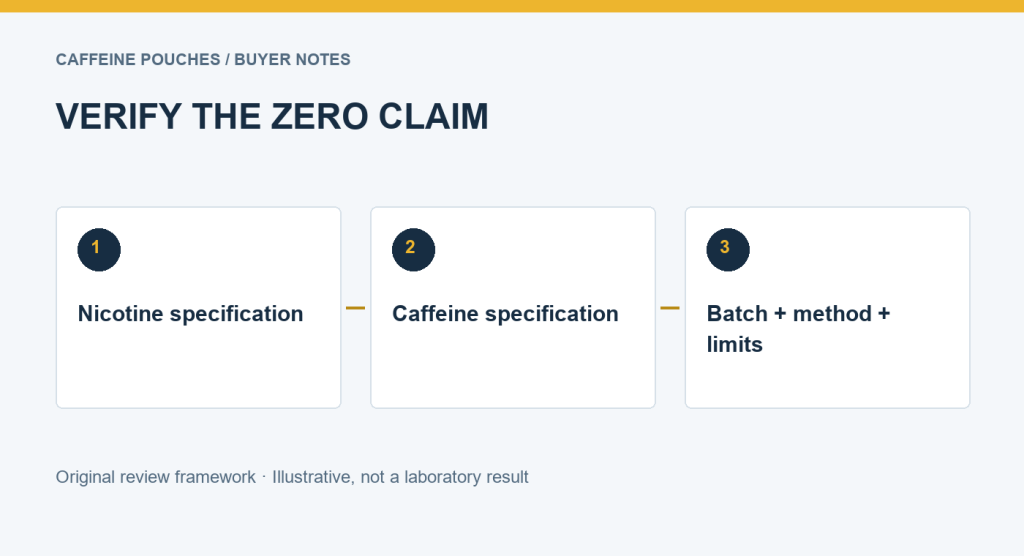
Start with the two substances the buyer wants to exclude
A request for a nicotine-free pouch may still allow caffeine. A request for an evening, caffeine-free pouch may exclude both. Put those requirements on separate lines in the development brief. “Zero pouch,” “clean energy” and a white pouch photograph do not settle either question.
Tobacco-free wording also needs care. FDA explains that non-tobacco nicotine can include synthetic nicotine. A statement about the source of nicotine therefore cannot, by itself, establish its absence. FDA’s non-tobacco nicotine overview explains this distinction.
A practical specification sheet
- Name each excluded substance, including nicotine and caffeine where applicable.
- List every intentional ingredient and the specification revision being reviewed.
- Identify botanical extracts and ask whether they contribute caffeine.
- Record the proposed claim, destination country and person responsible for reviewing the wording.
- Keep acceptance criteria and reporting units in the approved specification.
Read “not detected” with the laboratory method attached
A report saying “ND” is incomplete for a purchasing decision unless it explains the abbreviation and its reporting threshold. Detection and quantification are different analytical questions. Ask for the method, sample identity, limit of detection, limit of quantification and the basis used to report a non-detect. Do not convert a non-detect into an assertion that no molecule is present.
Keep units consistent
Consider a fictional report with a reporting threshold of 1 mg/kg and a pouch fill mass of 0.50 g. Multiplying 1 mg/kg by 0.00050 kg gives 0.00050 mg per pouch, or 0.50 micrograms. This illustrates a unit conversion only. It is neither a measured result nor a proposed legal threshold for a nicotine-free claim. A result reported per gram of dry fill cannot be compared directly with one reported per complete moist pouch without checking the basis.
Ask the laboratory whether its method is suitable for the actual pouch matrix. An accreditation certificate alone does not show that this particular substance, matrix and method fall within its accredited scope. ISO/IEC 17025 concerns laboratory competence; a buyer still needs to examine the relevant scope and report.
Connect the report to the product that will ship
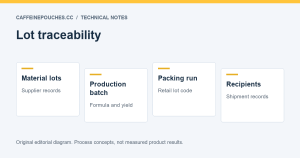
A certificate for a caffeine ingredient cannot establish the nicotine status of a finished can. Request a sample description and lot reference that connect the test to the finished product. Record who selected the sample, where it came from and whether it represents a development batch or a commercial batch.
For shared facilities, ask how ingredient storage, utensils, scheduling and cleaning are controlled. These are questions for supplier qualification, not claims that every manufacturer uses the same process. Agree what would trigger a new review: an ingredient source change, a different production location or a revised cleaning procedure, for example. Our change-control guide covers how to document such changes.
Check the purchase path as well as the laboratory file
Compare the can artwork, product page, carton label and order confirmation. The active substance and amount should be legible in the product variant the customer is buying. Similar colors across caffeine and nicotine ranges can create confusion even when the ingredient lists differ. Ask a reviewer who did not design the artwork to identify the active substance without prompting.
For a caffeine-free concept, send the complete exclusion brief for feasibility review. Availability, sensory performance and permission to use a claim must be confirmed for that project. This site’s caffeine pouch catalogue is not evidence that every zero-caffeine concept is already a stocked product.
Frequently asked questions
Is a no-added-caffeine declaration enough for a caffeine-free claim?
It describes an ingredient-addition decision. Review caffeine contributed by other ingredients and the finished-product evidence before approving caffeine-free wording.
Does one passing sample cover every future lot?
No. It describes the sample tested. Agree a sampling plan, ongoing controls and the changes that require a fresh review.
Can a nicotine-free product be described as a cessation treatment?
Do not infer a treatment claim from the absence of nicotine. Any cessation claim needs its own evidence and applicable regulatory review.
References and scope
This article provides a purchasing review framework. It does not certify a particular batch, establish clinical efficacy, or confirm permission to sell in a particular market.
For a project review, send the target market, proposed ingredient list and pack format through our contact page. See the buyer question center for related questions.