By CaffeinePouches.cc editorial team · Reviewed November 16, 2026 · Buyer education
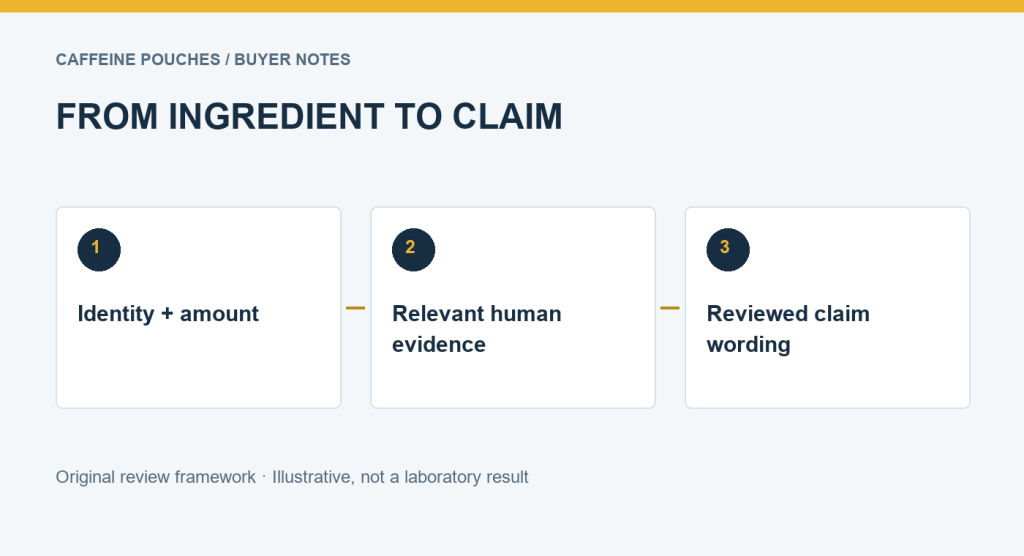
A list of familiar ingredients cannot tell a buyer whether a nootropic pouch delivers a demonstrated benefit. Build the evidence file around the proposed claim, the exact ingredients and amounts, and the finished product people will use.
Write the proposed claim before collecting studies
“Contains L-theanine” and “improves attention within ten minutes” require different support. The first concerns composition. The second also describes an outcome and a time course. Write the intended product-page sentence in the review file, including the audience, use instructions and duration of the claimed effect. This makes it possible to decide whether a study actually addresses the promise.
The FTC’s Health Products Compliance Guidance explains that both express and implied health claims need appropriate scientific support. Its examples are US advertising guidance, not premarket approval of this pouch category. A testimonial or an ingredient supplier’s sales slide does not resolve the evidence question.
Identify what is inside each ingredient name
For a botanical or mushroom proposal, request the scientific name, plant or fungal part, preparation method and any stated marker specification. Ask whether the quantity describes the extract as supplied or another equivalent. Keep the supplier specification and study material description together. “Mushroom blend” alone leaves too much unspecified for a meaningful comparison.
NIH Office of Dietary Supplements guidance emphasizes identity, purity, strength, composition and stability when characterizing research materials. These are useful review categories. They do not turn a commercial formulation into an NIH-endorsed product.
Use a mass budget before adding more ingredients
In a fictional 600 mg fill, allocating 420 mg to the carrier, flavor system and other supporting ingredients leaves 180 mg for the proposed active blend. Five ingredients at 100 mg each would require 500 mg before that supporting material is counted. The proposal does not fit the stated fill mass. These numbers illustrate formulation arithmetic, not an effective dose or a recommended formulation.
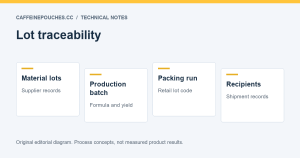
Record each ingredient’s quantity per pouch, the mass of its supplied preparation and the space available in the format. A total blend weight cannot reveal the individual quantities. If an amount is confidential, define who can review it under an appropriate confidentiality arrangement before commercial approval.
Compare the study with the proposed pouch
- Was the same ingredient preparation used, with a comparable composition?
- Was the amount per administration and frequency comparable?
- Did the study use a swallowed capsule, beverage or the actual pouch format?
- Did it measure the outcome the proposed wording promises?
- Were the participants relevant to the intended adult audience?
- Did the study examine one use or repeated use over weeks?
- Were adverse effects and study limitations reported?
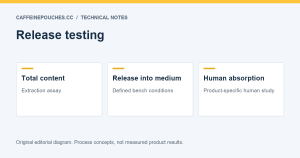
Mark each comparison as matched, different or unknown. A capsule study does not establish that all of an ingredient leaves an oral pouch or reaches the body in the same way. Laboratory release testing can help characterize the product, but cannot establish a cognitive benefit. See our release-testing guide for that boundary.
Keep composition testing separate from efficacy evidence
An assay can support the amount of an analyte in a tested sample. Contaminant testing addresses specified quality questions. Neither result demonstrates a memory or attention outcome. Store those reports in the quality file and keep the claim review linked to the relevant human evidence. This avoids presenting a laboratory badge beside a benefit claim that the laboratory never tested.
Make an explicit release decision on the wording
At artwork approval, record which claims are supported, which need narrower wording and which remain unsubstantiated. Keep the reviewed draft with its evidence references and approval date. Changing a blend later should reopen the relevant claim review, even if the front of the can looks the same.
For an OEM or ODM inquiry, supply the proposed ingredients and destination market first. A feasibility discussion can identify missing specifications and testing needs. It should not be treated as confirmation that a particular blend is effective, lawful in every market or ready for production.
Frequently asked questions
Does “nootropic” specify an ingredient or a tested benefit?
No. Review the actual ingredient list, quantities and the precise claim. The category name does not identify a standardized formula or an established outcome.
Can ingredient research support any pouch containing that ingredient?
Not automatically. Review preparation, amount, route, study duration and population before deciding what the evidence supports.
Can a certificate of analysis prove better focus?
A composition or contaminant report does not measure a focus outcome. Review the report for its stated analytical purpose.
References and scope
This article provides a purchasing review framework. It does not certify a particular batch, establish clinical efficacy, or confirm permission to sell in a particular market.
For a project review, send the target market, proposed ingredient list and pack format through our contact page. See the buyer question center for related questions.