
A checkweigher measures total passing mass. It does not automatically know how much blend is inside a pouch or whether the caffeine is uniform. Tare variability and the equipment's measurement capability determine what a weight result can support.
Editorial scope: technical development and supplier review. Published 16 November 2026. The study and control suggestions below are not reported results from this supplier.
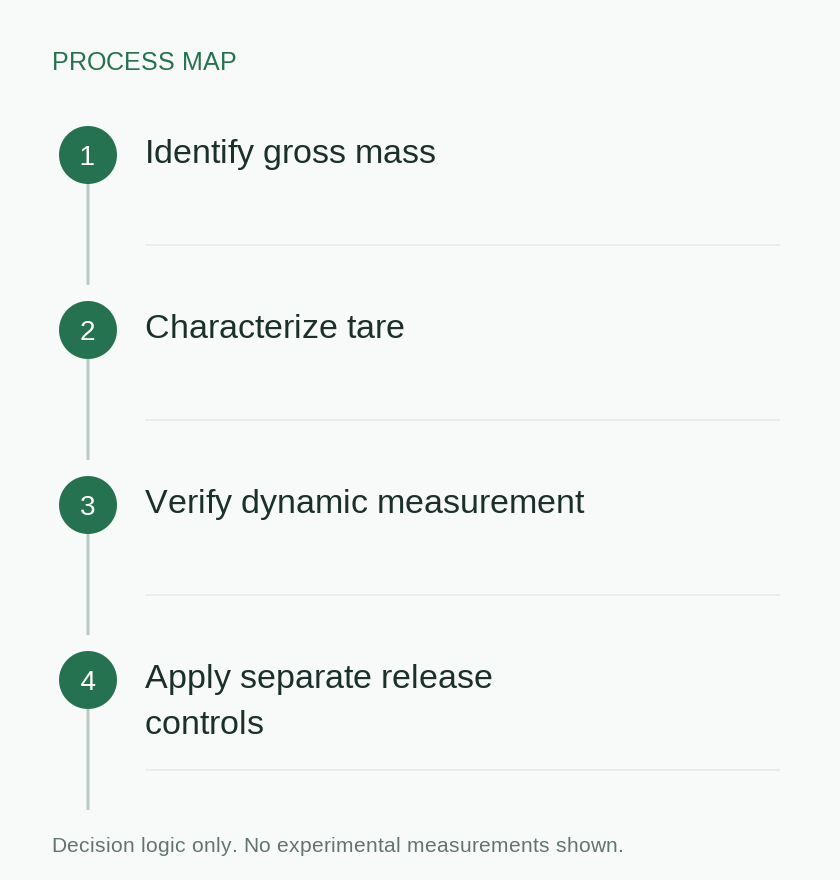
Define gross, tare and net mass
For individual pouches, the nonwoven and seam contribute to gross mass. For a can, the lid, label and container add further variation. Establish tare using representative components, then identify whether routine control weighs individual pouches or complete cans. A nominal tare deducted from every can can conceal variation in the packaging components.
Verify the measurement under operating conditions
Evaluate repeatability, resolution and performance at the actual line speed. Challenge the system using suitable reference items and document reject confirmation. Vibration and nearby airflow may matter. A balance check at rest is not a complete performance check for a dynamic checkweigher. Include start-up, after-adjustment and end-of-run controls in the instruction.
Link the signal to an appropriate decision
A mass check may flag underfill, missing units or unusual variation, but it does not directly measure active content. Pair it with the required content-uniformity and count controls. Define response to an out-of-limit trend before production. Decisions about labeled net quantity also need the destination market's rules; do not substitute a manufacturing target for a legal metrology requirement.
Development review checklist
- Identify the measurement point and packaging state.
- Characterize relevant tare variation.
- Verify dynamic performance at the proposed speed.
- Confirm rejected units are segregated.
- Keep count, net quantity and active-content decisions distinct.
Buyer questions
Can a correct can weight prove the pouch count?
Not alone. An overweight unit can offset a missing one. Use an appropriate count verification.
Does equal pouch weight prove equal caffeine?
No. Active concentration within the fill can vary even when mass is constant.
Why test the checkweigher at line speed?
Motion, vibration and timing affect dynamic performance.
Can one empty can establish tare for the whole order?
It is an inadequate characterization of component variation. Use a justified sampling plan.
What should happen after a reject-system failure?
Control the potentially affected interval, investigate and assess product disposition under the approved procedure.
References and scope
- FDA: ICH Q2(R2), Validation of Analytical Procedures
Fit-for-purpose analytical validation framework; pharmaceutical guidance used as technical background, not a certification for these products.
- FDA: Small Entity Compliance Guide, Dietary Supplement CGMP
Specifications and production records where dietary-supplement classification applies; not automatic classification of every oral pouch.
Discuss the specification and evidence needed for your project. Send the intended use, destination market and the attribute you need to verify. Commercial capability and acceptance criteria require a project-specific agreement.